

Patriots training camp opened with a clear news frame: New England is not only preparing for another NFL season, but also testing whether its roster depth matches the standard set by a strong first year under head coach Mike Vrabel. The camp began July 25, 2026, with 20 practices scheduled and 13 open to the public, according to the reported camp schedule. That structure gives coaches a long evaluation runway while also giving supporters multiple chances to see position competitions before preseason games sharpen the roster decisions.
The backdrop matters. Reporting on the opening of camp described this as Vrabel’s second season in charge after a 14-3 record and an AFC East title in his first year, while also noting key offensive additions and roster storylines in the camp storylines. That combination changes the tone of camp. A rebuilding team often uses July and August to identify core pieces. A division champion must do that while protecting standards, sorting roles and avoiding false comfort from last season’s results.
Patriots training camp schedule and staff baseline
Why Patriots training camp timing matters
The July 25 start and 20-practice format are more than calendar notes. Training camp is where installation, conditioning, roster sorting and situational football overlap. With 13 practices open to the public, New England also has a fan-facing element that can shape the rhythm around the team facility. Open practices do not decide the 53-man roster, but they can reveal which players are receiving repeated opportunities with certain units, which positions are rotating heavily and where the coaching staff is still searching for separation.
For Vrabel, the second-year context raises the evaluation bar. A first-year staff can spend camp teaching language, expectations and practice tempo. In year two, the focus can shift toward refinement. That does not mean the Patriots have settled every role. The research points to active competition at running back, receiver, tight end and edge rusher, along with depth questions behind Drake Maye at quarterback. A strong regular-season record in the prior year may increase expectations, but it does not remove the need to build a durable roster for a long NFL schedule.
Public practices and fan planning
Thirteen public practices also create a practical planning angle. Fans can evaluate camp sessions differently from preseason games because the environment allows more attention to position drills, special teams periods and repetitions for younger players. For those interested in diversifying their sports-related activities, FSGolf offers insights into golfing experiences that could intrigue football fans outside the NFL calendar.
Quarterback and backfield depth are early checkpoints
Drake Maye’s role and the backup picture
Drake Maye is positioned as the starting quarterback, with Tommy DeVito and Behren Morton listed as depth options in the research. That hierarchy gives camp a straightforward first question: how efficiently can the offense work around Maye while the staff evaluates the reserves? The practical question at Patriots training camp is not whether every quarterback gets equal attention. It is whether the offense can build timing with the starter while still giving the backup candidates enough snaps to be judged fairly.
Quarterback depth often looks abstract until a team has to use it. Camp is where the staff can assess huddle command, protection communication, red-zone choices and two-minute operation. Those elements rarely fit neatly into one public stat line, especially in practice settings. The available research does not provide detailed completion totals, interception counts or practice-by-practice performance data, so any firm ranking beyond the stated roles would go beyond what is supported. The safer reading is that Maye enters as the starter and the backup competition remains part of the broader roster evaluation.
Running backs under roster pressure
The backfield has a different kind of test. Rhamondre Stevenson and TreVeyon Henderson lead the position group in the research, while rookies Jam Miller and Myles Montgomery are competing for roster spots. That setup creates layered evaluation. The top backs need to show they can handle the offense’s main responsibilities, while the younger backs must make a case through rushing traits, receiving reliability, pass protection and likely special teams value.
Camp competition at running back is often about trust as much as explosiveness. A young runner can stand out with a sharp cut in an open practice, but coaches also need to know whether he can identify pressure, protect the quarterback and stay assignment-sound in situational work. The research does not include snap counts or coach comments, so the best supported view is that New England has both established options and rookie competition rather than a fully settled backfield order.
Pass-catching roles may define offensive flexibility
Receiver additions change the workload math
The receiver group is one of the most notable areas because the research says New England added A.J. Brown and Romeo Doubs. Those additions raise the competitive floor of the room and can reshape how targets are distributed. Kayshon Boutte is also mentioned in the research as a player tied to trade speculation, but that type of reporting should be treated cautiously unless team action confirms it. For camp analysis, the more reliable point is that the receiver room has more competition for roles, snaps and game-day spots.
Receiver depth affects more than the passing game. It changes personnel groupings, third-down packages and red-zone options. If Brown and Doubs are established parts of the plan, other receivers may have to win narrower roles through special teams, blocking, route precision or matchup-specific value. That is why Patriots training camp carries significance beyond the headline names. The players who do not lead the depth chart can still decide how flexible the offense becomes on game day.
Tight end depth behind Hunter Henry
Hunter Henry remains the primary tight end in the research, with rookies Eli Raridon and Jack Westover competing for backup roles. That is a meaningful camp battle because tight end depth can affect both run-game structure and passing-game spacing. A second tight end who can block credibly gives an offense more options without substituting. A receiving-oriented backup can help in red-zone or third-down packages, but only if the staff trusts him with assignments.
The Patriots do not need every backup tight end to mirror Henry’s role. They need to know which combinations can function in real offensive calls. Camp practices are useful for that because tight ends are tested in multiple settings: inline blocking, motion, route adjustments, special teams and protection checks. The research does not identify a winner in that competition, so the position should be viewed as open behind Henry based on the available information.
Defensive depth hinges on edge and corner stability
Edge rush options and availability
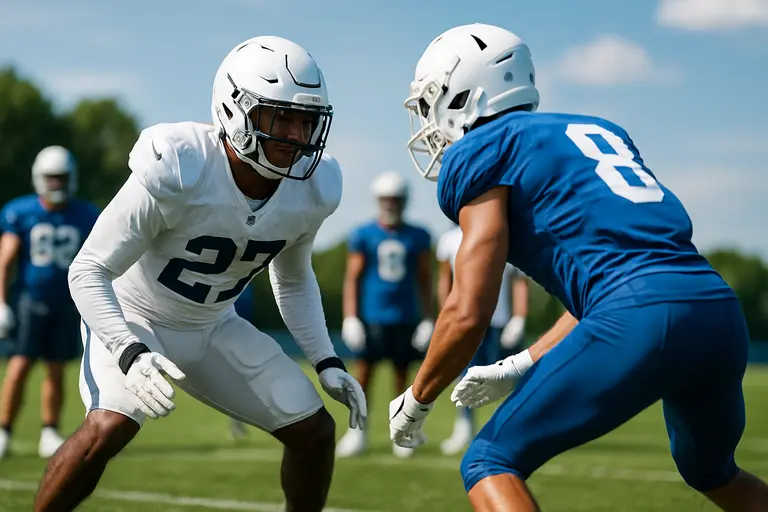
The edge group includes Harold Landry III and Dre’Mont Jones, with rookies such as Xavier Holmes trying to earn a role. That mix gives New England experience and developmental options, but availability is part of the early camp story. The research says Landry began camp on the physically unable to perform list, while tight end C.J. Dippre was also on PUP and running back Terrell Jennings was on the non-football injury list. Those designations are roster-status facts, not diagnoses, and the available research does not support any recovery timeline.
For the defense, edge depth can shape down-and-distance play calling. If the Patriots have multiple credible rushers, they can rotate more freely and avoid overloading one player early in the season. If the group is thinner than expected, the staff may need to adjust packages or ask interior defenders to handle more pressure responsibilities. Camp is where those contingency plans are tested before the games count.
Cornerback group gives the defense a base
The cornerback room is led in the research by Christian Gonzalez, Carlton Davis III and Marcus Jones. That trio gives the secondary a defined top group entering camp, though the exact deployment is not established in the provided material. Cornerback depth matters because modern NFL defenses face frequent three-receiver sets, motion, condensed formations and matchup stress. A team can have strong starters and still need reliable fourth and fifth corners across a full season.
This is where defensive roster construction becomes connected. A deeper corner group can support more aggressive coverage calls. A stronger edge rotation can help the secondary by shortening the quarterback’s time. The Patriots’ camp evaluation should therefore be read position by position, but not in isolation. Defensive depth works best when pressure and coverage fit together.
What Patriots training camp shows about roster depth
The clearest supported takeaway is that New England has multiple real evaluation points rather than one single camp question. The quarterback hierarchy starts with Maye. The backfield has established names and rookie challengers. The receiver room has new competition after the reported additions of Brown and Doubs. Henry anchors tight end, while backup roles remain available. On defense, the edge group is being measured alongside early availability designations, and the cornerback group has a defined leading trio.
That does not mean every competition is close, nor does it mean every player mentioned will make the final roster. The research does not provide final depth-chart decisions, practice grades or official cutdown outcomes. It supports a more cautious reading: Patriots training camp is testing whether a roster that already has high expectations can build enough depth to handle injuries, role changes and the weekly matchup demands of the NFL season.
For a team coming off a reported 14-3 season and AFC East title under Vrabel, camp is less about proving relevance and more about identifying reliable layers beneath the starters. That is where the 2026 Patriots will begin to separate stable roster construction from promising names on paper.
